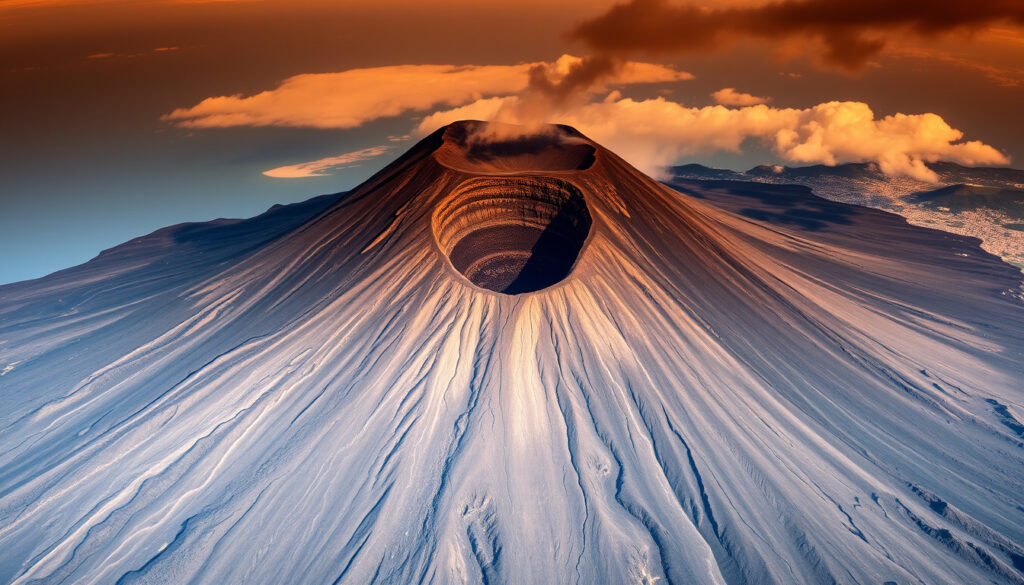
Mt Vesuvius – Eruption History, Visiting Guide and Safety Tips
Mount Vesuvius rises above the Bay of Naples in Campania, southern Italy, as one of the most closely watched volcanoes on the planet. It is famous for the catastrophic AD 79 eruption that buried Pompeii, Herculaneum, and other Roman settlements under meters of ash and pyroclastic material. Today, it is classified as an active volcano and is described by the Vesuvius National Park as the only active volcano in continental Europe.
It last erupted in 1944, and since then it has remained quiet but is still heavily monitored because it sits next to one of the most densely populated urban areas in the world. More than two million people live in the immediate surrounding zone, making Vesuvius a subject of continuous scientific study and public safety planning. The volcano is also one of the most visited natural landmarks in Italy, drawing travelers who want to see the crater and explore the archaeological sites left by its ancient eruption.
What happened during the Mount Vesuvius eruption of 79 AD that destroyed Pompeii?
- Vesuvius is best known for the catastrophic AD 79 eruption which preserved Pompeii under ash.
- It is the only volcano on mainland Europe to have erupted in the last century (1944).
- Over 3 million people live in the immediate danger zone, making it one of the highest-risk volcanoes in the world.
- Visitors can hike to the crater via the Gran Cono trail, but tickets must be booked in advance.
- The AD 79 eruption is described by sources as a Plinian eruption, producing a towering ash-and-gas column.
- A major earthquake in AD 62 preceded the eruption and is often cited as part of the volcanic unrest that led to AD 79.
| Attribute | Detail |
|---|---|
| Name | Mount Vesuvius (Italian: Monte Vesuvio) |
| Type | Stratovolcano (composite) |
| Location | Campania, Italy, 9 km east of Naples |
| Coordinates | 40°49′17″N 14°25′32″E |
| Elevation | 1,281 m (4,203 ft) |
| Last eruption | 17–23 March 1944 |
| Eruption style | Plinian to Vulcanian |
| Monitoring | INGV (Italian National Institute of Geophysics and Volcanology) |
| National Park | Parco Nazionale del Vesuvio (est. 1991) |
| Access | Gran Cono trail only; limited daily entry |
The AD 79 eruption is the most famous in Vesuvius’s history and is widely associated with the destruction of Pompeii, Herculaneum, Stabiae, and Oplontis. According to the American Museum of Natural History, the eruption was a Plinian event that produced a towering ash-and-gas column. The eruption buried Pompeii under ash, pumice, and pyroclastic material, preserving much of the city’s remains in extraordinary detail. Herculaneum was also destroyed, but its burial conditions differed, with more intense heat and different preservation effects than Pompeii.
When did Mount Vesuvius last erupt and what was the 1944 eruption like?
The 1944 eruption ended the volcano’s long cycle of historical activity. It produced lava flows, ash, and a crater that still defines the summit today. The eruption destroyed the town of San Sebastiano and ejected volcanic bombs that reached several meters in size.
The final phase of an active cycle
Vesuvius has a long eruptive history beyond AD 79 and 1944, with many eruptions recorded between 1631 and 1944. The 1944 event was the last confirmed eruption, and since then the volcano has remained in a dormant state. Scientists monitor it closely because it has shown repeated eruptive cycles in the past and could erupt again.
Vesuvius is heavily monitored by the INGV for seismic activity, ground deformation, and gas emissions. No signs of imminent eruption have been recorded as of 2025, but the long dormancy of over 80 years raises scientific concern, as high-pressure magma could lead to an explosive re-awakening. Vesuvius is still considered dangerous because it is active and sits near a densely populated region.
Can you visit Mount Vesuvius and how do you get tickets?
Yes, the volcano is open to visitors and is one of the most visited natural attractions in the Naples area. The main visitor experience is a trip to the crater area and the surrounding Vesuvius National Park. Typical visit patterns include pairing Vesuvius with a visit to Pompeii or Herculaneum, since the archaeological sites and the volcano are historically linked.
How to get tickets for Mount Vesuvius
Access to the summit and crater area is managed as a park visit, and visitors generally need a ticket for entry to the protected trail area. Ticketing details can vary by season, transport package, and whether the visit is for the crater alone or includes guided options. Travelers should check the official park site for current rates.
Access to the summit crater is managed through Vesuvius National Park. Tickets are generally required for the Gran Cono trail and should ideally be reserved ahead of time, particularly during the summer season when daily entry limits are reached quickly. Visitors often combine the trip with a visit to the Pompeii archaeological site, which requires a separate ticket.
The Gran Cono trail
The best-known trail is the trail to the crater, which is the standard hike for visitors who want views into the summit area. The park is organized around the Gran Cono and the broader Somma-Vesuvius volcanic complex, so hiking is focused on volcanic landscapes rather than long backcountry routes. The summit area is relatively accessible compared with many volcanoes, but trails can still be steep and exposed.
The hike from the ticket checkpoint to the crater takes about 30 to 40 minutes at a moderate pace. The trail is roughly 1.2 km and includes a steep gravel path. Comfortable hiking shoes are essential because the trail consists of loose volcanic rock. There is no shade on the upper cone, so sun protection and water are strongly recommended. There is a small kiosk near the ticket office and a refreshment point partway up, but no full restaurant at the summit.
For those organizing a broader Italian itinerary, travel guides like Flights to Gran Canaria – Compare Airlines, Prices & Top Tips can offer useful perspectives on booking travel efficiently.
How do you pronounce Mount Vesuvius and where is it located?
The standard English pronunciation is /vəˈsuːviəs/, commonly rendered as “veh-SOO-vee-us.” In Italian, the volcano is called Monte Vesuvio, pronounced “MOHN-teh veh-ZOO-vee-oh.”
Vesuvius rises above the Bay of Naples on the plain of Campania, with its western base near the bay. The volcano is located about 9 km east of Naples and is part of the Vesuvius National Park. The area is associated with UNESCO World Heritage status because of the archaeological remains from the ancient eruption. The distance between Pompeii and Vesuvius is roughly 10 km, making it easy to visit both sites in a single day.
Is Mount Vesuvius still active and is it dangerous?
Yes, Mount Vesuvius is still an active volcano. It is described by the Vesuvius National Park as the only active volcano in continental Europe. It is considered one of the most dangerous volcanoes in the world because of the large population living nearby. More than two million people live in the immediate area surrounding the volcano, and the broader Naples metropolitan area is densely populated.
Scientific monitoring is carried out by the INGV, which tracks seismic activity, ground deformation, and gas emissions. No signs of imminent eruption have been recorded as of 2025. However, the volcano’s long dormancy raises concern because very high-pressure magma may lead to explosive re-awakening. Contingency plans exist but remain untested at full scale.
Park visits are generally limited to designated routes in the protected area, which is part of how visitor safety and conservation are managed. The safest approach for visitors is to follow park rules, stay on marked trails, and check official park or civil-protection updates before traveling. The volcano is classified as an active volcano, and the alert level remains normal as of the latest available data.
What is the complete timeline of Mount Vesuvius eruptions?
- c. 17,000 years ago: Formation of Mount Somma, the older caldera that partially predates the current cone.
- AD 79: Catastrophic Plinian eruption destroys Pompeii, Herculaneum, Stabiae, and other settlements. Pliny the Younger records the event.
- 472: Eruption deposits ash over Europe and is documented by contemporary writers.
- 1631: Major eruption kills approximately 4,000 people; pyroclastic flows and lava reach the sea.
- 1794: Eruption destroys the town of Torre del Greco.
- 1906: Violent eruption causes extensive damage to surrounding towns.
- 1944: Last eruption destroys San Sebastiano and ends the volcano’s modern cycle of activity. Volcanic bombs reach several meters in size.
- 1991: Vesuvius National Park is established to protect the volcanic landscape and manage access.
- Present: Dormant but heavily monitored; the alert level remains normal, but scientific observation continues.
What is certain and what remains uncertain about Mount Vesuvius?
| Established information | Information that remains unclear |
|---|---|
| Vesuvius erupted in AD 79, 1944, and numerous other times throughout history. | The exact date of the next eruption cannot be predicted precisely. |
| It is an active volcano classified as a stratovolcano. | Whether the next eruption will be mild or catastrophic remains uncertain. |
| The 1944 eruption was the last confirmed eruption. | Long-term magma build-up trends are only understood through seismic and gas data. |
| Pompeii and Herculaneum were buried by pyroclastic material from the AD 79 eruption. | The full extent of damage a future eruption might cause is not fully known. |
What is the broader geological context of Mount Vesuvius?
Mount Vesuvius sits within the Campanian volcanic arc, which was formed by the subduction of the African plate under the Eurasian plate. Its unique destructive power in AD 79 was due to a Plinian eruption column and successive pyroclastic surges that swept down the slopes of the volcano. The eruption buried the surrounding Roman cities under thick layers of ash, pumice, and pyroclastic flow deposits, preserving them for centuries.
Modern risks are amplified by the dense urbanization around the volcano, particularly in the Naples metropolitan area. The volcano is heavily monitored for seismic activity, ground deformation, and gas emissions. The geological setting of Vesuvius means that it has the potential for highly explosive eruptions, which is why it remains a focal point for volcanological research and civil protection planning.
What are the key sources for Mount Vesuvius information?
Mount Vesuvius is considered one of the most dangerous volcanoes in the world because of the large population living nearby.
— British Geological Survey
“A cloud of unusual size and appearance… like a pine tree, for it shot up to a great height in a vertical trunk and then spread out like branches.”
— Pliny the Younger (Letters 6.20), describing the AD 79 eruption
Additional authoritative sources include the INGV monitoring data, the Vesuvius National Park official website, and the Smithsonian Institution’s Global Volcanism Program. For those interested in the archaeological side, the Pompeii official archaeological site provides extensive resources on the cities buried by the eruption.
Mount Vesuvius summary and travel planning
Mount Vesuvius is an active stratovolcano in southern Italy with a powerful historical legacy. Its most famous eruption in AD 79 destroyed Pompeii and Herculaneum, while its last eruption in 1944 marked the end of a long cycle of activity. Today, it is a protected national park and a major tourist destination, offering visitors the chance to hike to the crater and explore the preserved Roman cities at its base. Scientists continue to monitor the volcano closely, as it remains active and sits near a densely populated region. For travelers planning a broader trip, understanding accommodation options is helpful, and guides like Hotels in Manchester City Centre – Best Areas, Prices and Tips 2025 provide useful comparisons for booking stays.
Frequently asked questions about Mount Vesuvius
How long does it take to hike Mount Vesuvius?
The hike from the ticket checkpoint to the crater takes about 30–40 minutes at a moderate pace. The trail is roughly 1.2 km and includes a steep gravel path.
What should I wear when climbing Vesuvius?
Comfortable hiking shoes are essential because the trail is loose volcanic rock. Bring sun protection and water since there is no shade on the upper cone.
Are pets allowed on Mount Vesuvius?
Dogs are allowed on lead, but the gravel surface can be harsh on paws. Some sections may be restricted, so check park rules before visiting.
Can you see the crater of Vesuvius without climbing?
No, the crater is only accessible via the Gran Cono trail. There is no road or cable car to the top.
Is there a restaurant at the summit?
There is a small kiosk near the ticket office and a refreshment point partway up, but no full restaurant at the summit.
Does the Vesuvius ticket include entry to Pompeii?
No, tickets are separate. You need to book Pompeii archaeological site tickets independently.
How far is Mount Vesuvius from Naples city centre?
The distance is about 15 km (9 miles) as the crow flies. Driving takes 30–45 minutes; public buses from Naples to Ercolano or Pompeii plus shuttle are common.
What is the Italian name for Mount Vesuvius?
Monte Vesuvio (pronounced MOHN-teh veh-ZOO-vee-oh).
More related posts
 Sidney Poitier – Full Biography, Oscar Win and Lasting Legacy
 Vivienne Jolie-Pitt – Age, Maleficent Role and Family Facts 2025
 Lorraine Ed Warren – How They Died and Their Last Cases
 Sam Rivers – Limp Bizkit Bassist Dies at 48
 Chris Robinson – Singer Biography, Net Worth, Wife and Career
 How Much Is a 1st and 2nd Class Stamp – Latest 2026 Prices
 Perchance AI – Free Unlimited AI Generation Guide 2025
 Burkina Faso – Capital, President, Religion and Travel Risks 2025
