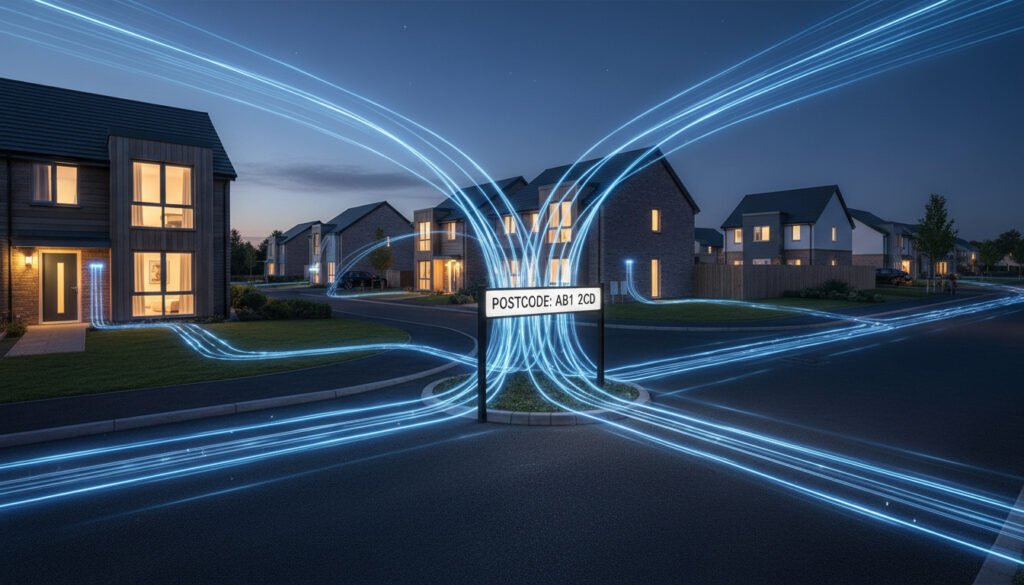
Fibre Broadband in My Area – Postcode Checker and Providers
Millions of UK households can now access fibre broadband, but availability varies dramatically by postcode. Understanding whether full fibre (FTTP), part-fibre (FTTC), or alternative technologies reach your specific address requires checking official tools from Openreach, Ofcom, and individual providers.
Recent data indicates FTTP coverage has reached 78% of UK homes, while older FTTC technology covers 98%. However, actual speeds and provider options depend on precise location factors including street cabinet proximity and ongoing rural rollout schedules.
This guide examines how to verify availability, interpret technical differences between connection types, and navigate provider choices based on verified industry data.
How to Check If Fibre Broadband Is Available in Your Area
|
Availability
Postcode checker tools determine FTTP, FTTC, and cable status instantly via official databases |
Speeds
Up to 1Gbps+ via FTTP; 30-80Mbps via FTTC; 10-11Mbps ADSL fallback |
Providers
Openreach network (BT, Sky, Vodafone), Virgin Media cable, and alt-nets including GoFibre |
Avg Cost
£25-£50 monthly depending on speed tier, technology type, and contract length |
- Ofcom’s official checker displays availability via colour-coded icons (green for generally available, amber for some properties, red for unavailable)
- Openreach’s fibre checker identifies immediate connection readiness across networks used by multiple ISPs
- Comparison sites like Uswitch aggregate deals from BT, Virgin Media, Plusnet, and alternative networks
- Rural users should verify GoFibre, Fibrus, and BRSK for dedicated rural network coverage
- Availability can vary between houses on the same street due to cabinet distances and cable routing
- Project Gigabit vouchers may subsidise connections in eligible hard-to-reach areas
- Actual installation requires engineer visits for FTTP unless the property was previously enabled
| Fact | Detail |
|---|---|
| FTTP Coverage | 78% of UK premises (17.1 million+ homes) |
| FTTC Coverage | 98% of UK premises |
| Virgin Media Coverage | Approximately 60% of UK |
| Maximum FTTP Speed | Up to 1.6Gbps (provider dependent) |
| Typical FTTC Speed | 30-80Mbps download |
| ADSL Fallback | 10-11Mbps, available to 99% |
| Superfast Availability | 97% of premises (30Mbps+) |
| Installation Timeframe | 1-4 weeks for new FTTP connections |
| Ofcom Baseline Date | December 2023 (57% FTTP then, now superseded) |
| Current FTTP Growth | Approximately 10% annually |
| Rural Priority Regions | Scotland, Northern England, Wales via alt-nets |
| Price Variation | Up to £329 savings possible via comparison tools |
What Is Fibre Broadband? FTTC vs FTTP Explained
Fibre broadband utilises optical fibre cables rather than traditional copper telephone lines. The technology splits into two primary categories determining speed, reliability, and installation requirements.
What is fibre broadband?
Unlike ADSL which relies entirely on copper wiring from the exchange, fibre broadband uses light signals transmitted through glass or plastic cables. This fundamental shift allows significantly higher data transmission rates with less signal degradation over distance. The UK market recognises two distinct fibre implementations: Fibre to the Cabinet (FTTC) and Fibre to the Premises (FTTP).
FTTC vs FTTP: The technical distinction
FTTC runs fibre optic cables to street cabinets, then uses existing copper wiring to reach individual homes. This hybrid approach delivers speeds of 30-80Mbps but performance deteriorates over distance from the cabinet. FTTC covers 98% of UK premises according to Ofcom data.
FTTP brings fibre directly into buildings, eliminating copper entirely. This full-fibre approach supports gigabit speeds (1,000Mbps+) with symmetrical upload rates, offering significantly greater reliability and future-proofing. Current industry data places FTTP availability at 78% of homes, a substantial increase from Ofcom’s December 2023 baseline of 57%.
While FTTC reaches 98% of UK premises, FTTP availability stands at 78% according to current comparison site data, though Ofcom’s December 2023 figures cited 57%, indicating rapid recent expansion across 17.1 million homes.
Top Fibre Broadband Providers, Speeds, and Costs
Which providers offer full fibre?
The UK market divides between Openreach-based providers (BT, Sky, Vodafone, Plusnet), Virgin Media’s distinct cable network, and alternative networks (alt-nets). Openreach’s infrastructure powers the majority of FTTP and FTTC services, accessible through multiple retail brands.
Virgin Media operates independently with cable services reaching approximately 60% of premises. Alt-nets including GoFibre (focusing on Scotland and northern England), Fibrus (Northern Ireland and other regions), Vodafone, and BRSK deploy separate physical networks in underserved areas. BRSK indicates status through categories: ready, in build, or coming soon.
What speeds can you expect?
Speed guarantees vary by provider and postcode. FTTC speeds depend on cabinet distance, typically ranging 30-80Mbps. FTTP offers consistent performance regardless of distance, with packages commonly offering 150Mbps, 300Mbps, 500Mbps, and 1,000Mbps tiers. Virgin Media provides cable services up to 1Gbps where infrastructure exists.
Ofcom’s December 2023 statistics indicated that most UK homes receive at least 10Mbps download and 1Mbps upload speeds, though full fibre significantly exceeds these minimums.
How pricing varies by technology
Comparison data from Compare the Market indicates potential savings up to £329 when switching providers. Unlimited data now represents the standard across fibre packages. GoFibre specifically structures offerings at 150Mbps, 300Mbps, 500Mbps, and 1,000Mbps price points tailored to rural Scottish and northern English markets.
If fibre is currently unavailable, GoFibre encourages rural residents to register interest, which directly influences future rollout prioritisation schedules in Scottish and northern English villages.
Fibre Broadband Installation and Rollout Timeline
How long does installation take?
Installation durations vary by existing infrastructure. Properties with confirmed FTTP availability connect within days if previously enabled by engineers. New fibre installations typically require one to four weeks including engineer scheduling, external cabling work, and internal equipment setup. Postcode checkers indicate immediate readiness status versus planned construction phases.
Rural availability and Project Gigabit
Rural expansion continues through Project Gigabit, targeting hard-to-reach communities where commercial viability previously limited investment. The GOV.UK gigabit checker serves England and Wales specifically, indicating voucher eligibility and construction phases.
GoFibre maintains specific focus on overlooked Scottish and northern English villages, offering immediate connection where infrastructure exists and registration for areas still under development. National rollout continues postcode-by-postcode with 2025 targets under government schemes across England, Wales, Scotland, and Northern Ireland equivalents.
Availability can differ between adjacent properties. Always verify using your specific address rather than general postcode data, as cabinet connections and cable runs vary street by street according to network planning records.
Timeline of UK Fibre Infrastructure Development
- : Nationwide FTTC rollout begins, replacing pure ADSL infrastructure and establishing fibre-to-the-cabinet as the standard
- : Project Gigabit announced with government commitment to subsidise connections in hard-to-reach areas
- : Ofcom reports baseline 57% FTTP coverage alongside 98% FTTC availability
- : Rapid FTTP expansion reaches 78% coverage according to industry data, adding millions of premises
- : Government targets 85% gigabit-capable coverage nationwide under current infrastructure plans
- : Ongoing PSTN switch-off aims to retire copper networks, though exact dates vary by region
- : Postcode-by-postcode upgrades continue daily through Openreach and alternative network providers
Established Facts and Outstanding Uncertainties
| Established Information | Information That Remains Unclear |
|---|---|
| FTTP covers 78% of UK premises; FTTC reaches 98% | Exact FTTP completion dates for specific postcodes beyond current “coming soon” classifications |
| Installation requires 1-4 weeks for new FTTP connections | Final 2025 coverage percentages pending ongoing construction velocity |
| GoFibre, Fibrus, and BRSK operate distinct rural networks separate from Openreach | Prec关系到 copper switch-off schedules for individual exchanges |
| Postcode checkers provide live availability data via Ofcom and Openreach databases | Whether specific rural locations will qualify for Project Gigabit vouchers versus commercial builds |
| Virgin Media cable alternative covers approximately 60% of premises | Actual speeds at specific addresses before installation and line testing |
The Context Behind Britain’s Fibre Upgrade
The UK’s transition from copper to fibre represents the largest telecommunications infrastructure shift since broadband’s initial introduction. Full fibre supports contemporary requirements including remote working, cloud services, high-definition streaming, and future smart-home technologies that copper networks cannot sustain.
Government initiatives including Project Gigabit specifically target the “final third” of premises in rural and remote locations where commercial rollouts prove economically challenging. This geographic disparity explains why urban centres typically enjoy faster availability than rural villages, creating a digital divide that policy interventions aim to close through targeted subsidies and alternative network investments.
The shift carries implications beyond consumer convenience, affecting property valuation, business relocation decisions, and educational access. How Many Moons Does Saturn Have – 285 Confirmed as of 2026 illustrates how data verification standards apply across technical fields, from astronomical observation to telecommunications infrastructure reporting.
Industry Sources and Official Statements
“Fibre coverage is growing 10% yearly as network operators accelerate deployment schedules.”
— Ofcom Infrastructure Reports, December 2023
“Rural communities in Scotland and northern England require specific registration to trigger local builds and influence prioritisation queues.”
— GoFibre Network Planning Documentation
Summary
Verifying fibre availability requires postcode-specific checks through official regulatory tools and provider databases. With FTTP reaching 78% of homes and alternative networks expanding rural coverage through targeted initiatives, most UK households now qualify for superfast or ultrafast services. Those seeking convenient fitness facilities while managing their broadband upgrade might explore The Gym Group Near Me – UK Locations, Hours and Prices for nearby facilities, while checking broadband comparison tools ensures optimal connectivity choices.
Frequently Asked Questions
Why isn’t fibre broadband available everywhere?
Infrastructure requires significant capital investment. Providers historically prioritised densely populated areas where costs per premises remain lower. Rural locations face geographic barriers and lower commercial returns, though Project Gigabit subsidies now address these gaps through government support.
Can I get fibre broadband in rural areas?
Yes. Alternative networks including GoFibre specifically target Scottish and northern English villages, while Fibrus focuses on Northern Ireland. Project Gigabit vouchers assist hard-to-reach communities. Registering interest with providers influences local rollout prioritisation.
How long does fibre installation take?
Typically one to four weeks from order to activation, depending on whether your property requires new external cabling. Previously enabled premises may connect within days. Engineers must install an Optical Network Terminator for FTTP connections.
What is the current UK coverage percentage?
FTTP reaches approximately 78% of homes, while FTTC covers 98%. Virgin Media cable serves roughly 60%. These figures fluctuate as builds continue daily across postcode regions.
Which availability checker is most accurate?
Ofcom’s official broadband checker provides regulator-verified data with colour-coded availability indicators. Openreach’s tool offers network-specific details for their infrastructure. Cross-referencing multiple tools yields the most reliable confirmation.
Do I need different equipment for full fibre?
Yes. FTTP requires an Optical Network Terminator (ONT) installed by engineers, replacing traditional copper phone socket connections. This device converts optical signals for your router. FTTC uses existing phone lines with modified faceplates.
Will copper broadband networks disappear?
The PSTN switch-off aims to retire copper networks, with target dates around 2025-2026. However, exact timing varies by region and provider migration schedules. FTTP availability determines whether premises can transition smoothly from copper dependencies.
More related posts
 158 cm in Feet – Exact Height Conversion and Context
 Harper Vivienne Ann Lockwood – Biography, Age and Family Facts
 Mona Lisa – History, Theft, and Why It’s So Famous
 Kilmarnock FC vs Rangers FC Stats – Head-to-Head, Form & Predictions
 Danielle Harold – Age, Career, and Charity Work
 Ac Repair Near Me – Costs, Signs and Reliable Fixes
 Ryan Coogler – Biography, Films, Net Worth and Next Movie
 Robb Stark – The Young Wolf, His Death and Legacy
