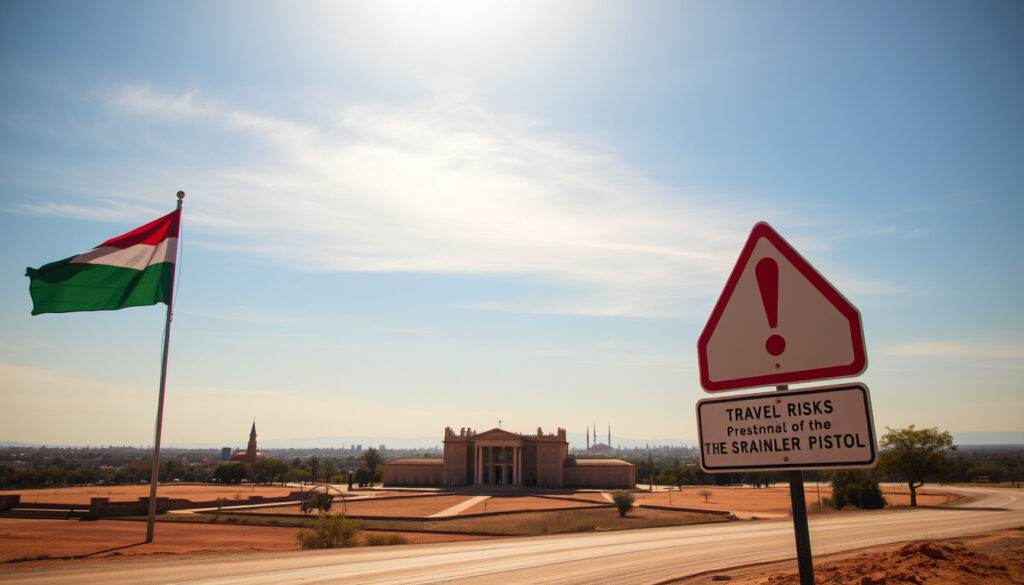
Burkina Faso – Capital, President, Religion and Travel Risks 2025
Burkina Faso is a landlocked West African country whose capital and largest city is Ouagadougou. The head of state is Captain Ibrahim Traoré, who leads a transitional military government that has held power since two coups in 2022. Recent estimates place the population at roughly 23.3 million to 24.1 million, and the country uses the West African CFA franc (XOF) as its currency.
For much of the past decade, Burkina Faso has faced a security crisis driven by jihadist insurgent groups. The violence has affected travel, governance, and internal displacement, while repeated droughts and climate stress have deepened food insecurity across the country.
What is the capital of Burkina Faso?
The capital of Burkina Faso is Ouagadougou. Britannica describes it as a modern city and the seat of government, and the Ouagadougou capital is the country’s political, administrative, communications, cultural, and economic center.
Burkina Faso is a landlocked West African state, and Ouagadougou lies near the center of the country. The surrounding landscape consists mainly of an extensive plateau covered by savanna, with sparse forests appearing in the south.
Recent population estimates for Burkina Faso range from about 23.3 million to 24.1 million in 2024–2025, depending on the source and the date of the estimate. Ouagadougou recorded 2,415,266 residents in the 2019 census, while newer projections place the city’s population between roughly 3.15 million and 3.20 million.
- A history of coups: Burkina Faso has experienced multiple military takeovers, the most recent in 2022.
- A severe security crisis: Armed Islamist groups linked to al-Qaeda and the Islamic State in the Greater Sahara operate across the country, causing thousands of civilian deaths and widespread displacement.
- Diverse society: More than 60 ethnic groups live in Burkina Faso, alongside a mix of Islam, Christianity, and indigenous beliefs.
- High travel risk: Many governments strongly discourage travel because of terrorism, kidnapping, and armed attacks.
- Capital as hub: Ouagadougou is the political, administrative, cultural, and economic heart of the country.
- National currency: The West African CFA franc (XOF) is the country’s currency.
- Climate pressure: Recurring droughts and climate stress deepen food insecurity and drive displacement.
| Attribute | Details |
|---|---|
| Capital | Ouagadougou |
| Population (2024 estimate) | ~23,286,000 |
| Area | 274,200 sq km (105,869 sq mi) |
| Official Languages | French (official), Mooré, other local languages |
| Religion | Islam ~63%, Christianity ~25%, Indigenous ~12% |
| Currency | West African CFA franc (XOF) |
| Government | Unitary military junta, president Ibrahim Traoré |
| Prime Minister | Rimtalba Jean Emmanuel Ouédraogo (since Dec 2024) |
| GDP (nominal, 2023) | ~$20 billion |
| Independence | From France in 1960 (as Upper Volta) |
| Current Crisis | Jihadist insurgency since 2015, two coups in 2022 |
| Travel Advisory | Do not travel (UK FCDO, US State Dept) |
Who is the President of Burkina Faso?
Captain Ibrahim Traoré has been the president of Burkina Faso since September 2022. He took power in a coup that followed the January 2022 takeover by Paul-Henri Sandaogo Damiba, making it the country’s second military coup of that year. The BBC country profile describes the authorities leading the country since then as a transitional military administration.
The current transition began after the September 2022 takeover, with the constitution suspended and transitional authorities holding power.
Who is the Prime Minister of Burkina Faso?
Rimtalba Jean Emmanuel Ouédraogo has served as Prime Minister since December 2024. He holds the post within the transitional military government led by President Traoré.
What type of government does Burkina Faso have?
Since the 2022 coup, Burkina Faso has been under a military junta. The constitution is suspended, and transitional authorities hold power. The country is formally a unitary state, though its normal constitutional order has been set aside during the transition.
The transitional government has not announced a concrete timetable for elections. Its stated priority is restoring security, but the insurgency remains active across much of the country.
What is the main religion in Burkina Faso?
Burkina Faso is predominantly Muslim, with Islam the largest religion in the country alongside Christian and traditional beliefs. Country profiles put Islam at roughly 63 percent of the population, Christianity at about 25 percent, and indigenous beliefs at around 12 percent, though exact figures vary. That broad picture is consistent across standard country references.
What is the official language of Burkina Faso?
French is the official language, used in government, administration, and education. Many indigenous languages are widely spoken, including Mooré, Dioula, and Fula.
What ethnic groups are in Burkina Faso?
The Mossi are the largest ethnic group, at about 40 percent of the population. The Fulani (or Peul), Gurma, Bobo, and many other communities make up the rest — more than 60 groups in total.
What is the currency of Burkina Faso?
The currency of Burkina Faso is the West African CFA franc (XOF).
Burkina Faso’s economy rests mainly on agriculture and gold mining. Cotton, cashews, and shea nuts are key agricultural products, and the country is one of Africa’s top gold producers.
Despite its mineral and agricultural resources, Burkina Faso remains one of the world’s poorest countries, with a young and rapidly growing population. The nominal GDP was estimated at roughly $20 billion in 2023.
What are the latest Burkina Faso news?
In 2024 and 2025, the central political development in Burkina Faso has been the continued rule of Captain Ibrahim Traoré as transitional president. The government continues to frame the conflict as a fight against jihadist groups, while international concern remains focused on stability, governance, and civilian safety. Multiple sources describe a worsening security crisis, with attacks by armed Islamist groups linked to al-Qaeda and the Islamic State in the Greater Sahara (ISGS).
What is the security situation in Burkina Faso?
The security situation is severe and has been deteriorating for years. Armed groups regularly attack civilians and security forces, and the state’s control over rural areas is fluid. Human Rights Watch estimates that at least 1,800 civilians were killed between 2023 and 2025. The violence has also displaced more than two million people within the country.
Is Burkina Faso safe to travel to?
Travel to Burkina Faso is generally considered high risk. Terrorism, kidnapping, armed attacks, road insecurity, and volatile regional conditions are the main concerns. The UK Foreign, Commonwealth & Development Office advises against all travel to the country, and travel advisory details can change quickly.
The UK FCDO and many other governments advise against all travel to Burkina Faso because of the high risk of terrorism and kidnapping. Armed attacks and road insecurity add to the danger in several regions.
What is Burkina Faso FC?
In football discussions, “Burkina Faso FC” generally refers to the national team, whose official nickname is “Les Étalons” (The Stallions). The Stallions have qualified for the Africa Cup of Nations multiple times and reached the semifinals in 2013.
What is Burkina Faso’s history of coups?
Burkina Faso’s political history since independence has been turbulent, with military takeovers a recurring feature. The events below are documented in BBC and Britannica country profiles and in reporting by Human Rights Watch.
- — Independence from France as Upper Volta.
- — The country is renamed Burkina Faso under Thomas Sankara.
- — Thomas Sankara is assassinated in a coup led by Blaise Compaoré.
- — Blaise Compaoré is ousted after a popular uprising.
- — A coup attempt fails; new elections bring Roch Marc Christian Kaboré to power.
- — Two military coups: Paul-Henri Sandaogo Damiba takes power in January, Ibrahim Traoré in September.
- – — Jihadist violence escalates; Human Rights Watch documents at least 1,800 civilian deaths.
- — Burkina Faso, Mali, and Niger form the Alliance of Sahel States.
- — Political instability and high security risks continue.
What is certain and what remains unclear about Burkina Faso?
Some facts about Burkina Faso are firmly established. Others are difficult to pin down because of the fast-moving security and political situation.
- Ouagadougou is the capital.
- The population is approximately 23.3 million (2024 estimate).
- Islam is the majority religion.
- Ibrahim Traoré is the current transitional president.
- Burkina Faso uses the West African CFA franc (XOF).
- The exact number of civilians killed in the insurgency varies by source; Human Rights Watch estimates at least 1,800 deaths between 2023 and 2025.
- The extent of government control over rural areas is fluid and hard to verify.
- The prime minister’s role and the structure of the government may shift as the junta consolidates power.
- Travel advisory details may change rapidly; official sources carry the most current guidance.
What does the current crisis mean for Burkina Faso?
Burkina Faso is caught between two overlapping crises: a jihadist insurgency that has displaced millions and a political crisis defined by military rule. The 2022 coup was partly a response to the failure to contain the insurgency, yet violence has continued since the junta took power. The government of Ibrahim Traoré has also shifted its international position, moving away from Western partners toward Russia and other allies.
The security situation remains dire. Attacks on civilians and security forces are ongoing, and the humanitarian impact is critical. Burkina Faso is one of the world’s poorest countries, reliant on agriculture and gold mining, and millions of people are in need of aid. The World Food Programme is one of the organizations involved in the emergency response.
Recurring droughts and climate stress add to these pressures, deepening food insecurity and forcing more people from their homes.
What do key sources say about Burkina Faso?
Authoritative sources on Burkina Faso include Encyclopaedia Britannica, the BBC, Human Rights Watch, and government travel advisories. Their reporting spans the country’s geography, political fragility, and humanitarian crisis.
Burkina Faso, a landlocked country in western Africa, occupies an extensive plateau characterized by a savanna that is grassy in the north and gradually gives way to sparse forests in the south.
Encyclopaedia Britannica
Burkina Faso has suffered from recurring droughts and military coups.
BBC country profile
In Burkina Faso, government forces have been fighting Islamist armed groups for more than a decade, killing of at least 1,800 civilians between 2023 and 2025.
Human Rights Watch
What is the essential summary of Burkina Faso?
Burkina Faso is a landlocked West African country of roughly 23 million people, with Ouagadougou as its capital and the CFA franc as its currency. Since 2022, it has been governed by a military transition under President Ibrahim Traoré, while a jihadist insurgency continues to drive violence, displacement, and humanitarian need. The country’s history of coups, its religious and ethnic diversity, and its current security crisis make it one of the most volatile and closely watched countries in the region. For a broader overview, consult the Burkina Faso country profile prepared by Encyclopaedia Britannica.
What questions are most frequently asked about Burkina Faso?
What is the flag of Burkina Faso?
The flag consists of two horizontal stripes — red on top and green on the bottom — with a yellow five-pointed star in the center. Red symbolizes the revolution, green represents agriculture and hope, and the star stands for the revolution’s guiding light.
What is the economy of Burkina Faso based on?
Agriculture and gold mining are the mainstays of the economy. Cotton, cashews, and shea nuts are key products, and the country is one of Africa’s top gold producers. It remains poor, with a young and rapidly growing population.
What is the Burkina Faso national football team called?
The national team is nicknamed “Les Étalons” (The Stallions). It has qualified for the Africa Cup of Nations multiple times and reached the semifinals in 2013.
How many people have been killed in Burkina Faso’s conflict?
Human Rights Watch estimates that at least 1,800 civilians were killed between 2023 and 2025. Since the conflict emerged around 2015, thousands of people have died, and more than two million have been internally displaced.
Where is Burkina Faso located?
Burkina Faso is a landlocked country in West Africa. It sits on a plateau dominated by savanna, with Ouagadougou near the center of the country.
What is the population of Burkina Faso?
Recent estimates put the population at roughly 23.3 million to 24.1 million in 2024–2025. Ouagadougou recorded about 2.4 million residents in the 2019 census, with later projections closer to 3.15 to 3.2 million.
More related posts
 Morfydd Clark – Age, Height, Movies and Personal Life
 Hero Fienne -Tiffin – Age, Height, Movie & Biography 2025
 Arslanbek Makhmudov – Career Record Next Fight and Bio
 Grey’s Anatomy – Season 22 Cast, Schedule & Streaming Info
 Are Oats Gluten Free – Complete Guide to Safety and Certified Brands
 Christopher Chung – Biography, Career & FAQs
 Seema Jaswal – Husband, Children, Religion, Salary and Biography
 The Great British Sewing Bee – Series 11 Winners Judges Highlights
