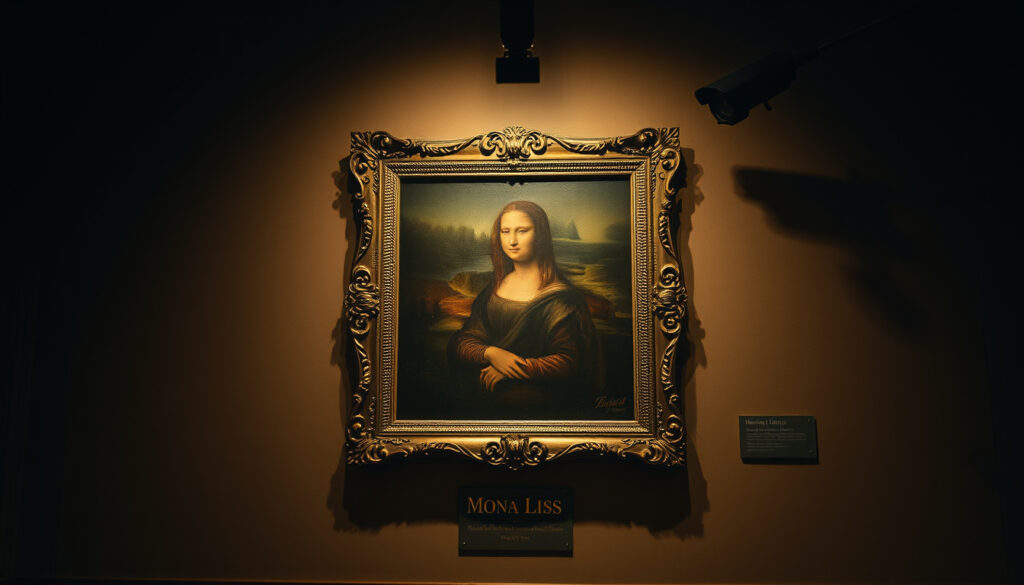
Mona Lisa – History, Theft, and Why It’s So Famous
The Mona Lisa is more than a painting; it is a cultural phenomenon. Created by Leonardo da Vinci in the early 16th century, this portrait of a Florentine woman draws millions of visitors to the Louvre Museum in Paris each year. Its fame, however, is not solely due to artistic mastery. A brazen 1911 theft from the Louvre Museum turned a respected Renaissance work into a global obsession.
Today, the Mona Lisa is widely considered the most valuable and famous artwork in history. Its value is legally incalculable, but its cultural footprint is undeniable. This article explores the painting’s origins, its subject, the theft that made it a legend, and its enduring worth.
Why Is the Mona Lisa So Famous?
The Mona Lisa’s fame is a product of both artistic brilliance and historical coincidence. Leonardo’s use of sfumato, the subject’s enigmatic expression, and the balanced composition exemplify High Renaissance ideals. But it was the 1911 theft that catapulted it from a respected masterwork into a global celebrity.
Artist
Leonardo da Vinci
Year Painted
c. 1503–1519
Location
Louvre Museum, Paris
Material
Oil on poplar panel
Key Insights
- The Mona Lisa’s fame stems from a combination of Renaissance mastery, its mysterious smile, and its notorious 1911 theft.
- The painting is valued at over $800 million USD (2025 insurance estimates), making it arguably the most expensive painting ever.
- The identity of the sitter is widely accepted as Lisa Gherardini, a Florentine woman, though some debate persists.
- The Mona Lisa’s small size (77 cm × 53 cm) surprises most viewers who expect a large canvas.
Snapshot Facts
| Fact | Detail |
|---|---|
| Title | Mona Lisa (La Gioconda) |
| Artist | Leonardo da Vinci |
| Year | c. 1503–1519 |
| Medium | Oil on poplar wood panel |
| Dimensions | 77 cm × 53 cm (30 in × 21 in) |
| Location | Louvre Museum, Paris (Room 711) |
| Subject | Lisa Gherardini, wife of Francesco del Giocondo |
| Theft | Stolen 1911, recovered 1913 |
| Estimated Value | Over $800 million (2025) |
When and How Was the Mona Lisa Painted?
Leonardo da Vinci began work on the Mona Lisa between 1503 and 1506, though he may have continued refining it as late as 1517. This extended timeline reflects Leonardo’s habit of carrying works with him for years, perfecting details.
Materials and Technique
The painting is executed in oil on a white poplar panel. Leonardo employed sfumato, a technique that creates soft, blurred transitions between colors and tones. This method gives the Mona Lisa its characteristic smoky quality and contributes to the ambiguity of her expression.
How Long Did It Take?
There is no precise record of the total time Leonardo spent on the portrait. It is believed he worked on it intermittently over roughly 16 years. The work may have remained in Leonardo’s possession until his death in 1519, never delivered to the Giocondo family.
Leonardo’s use of sfumato in the Mona Lisa is considered a defining achievement of the High Renaissance. The technique blurs hard lines, making the smile appear both present and elusive depending on the viewer’s focus.
Who Was the Real Mona Lisa (Lisa Gherardini)?
The painting traditionally depicts Lisa Gherardini (1479–1542), the wife of Florentine nobleman Francesco del Giocondo. In French, she is called La Joconde, and the painting itself is referred to as La Joconde.
A Real Person?
Yes, the individual in the portrait is widely accepted as a real historical figure. Lisa Gherardini was a member of the Florentine gentry. She married Francesco del Giocondo, a silk merchant, at a young age. Most historians agree the commission was to celebrate the birth of the couple’s second son.
How Did Mona Lisa Die?
Lisa Gherardini died in 1542 at the age of 63, likely from natural causes. She was buried in Florence. The painting, of course, long outlived its subject and went on to achieve worldwide fame.
What Happened During the Mona Lisa Theft?
On August 21, 1911, the painting was stolen from the Louvre in what was called the “heist of the century.” Before this event, the Mona Lisa was relatively obscure—merely one of many admired works in the museum.
The Thief and His Method
The culprit was Vincenzo Peruggia (1881–1925), a 29-year-old Italian handyman and patriot who believed Leonardo’s work should belong to Italy. Peruggia disguised himself in a white laborer’s smock, entered the closed Louvre early Monday morning, removed the painting from its glass case in the Salon Carré, and walked out with it hidden under his clothes.
The Aftermath
Peruggia hid the painting in his Paris home for two years before attempting to sell it to antique dealers in Florence in 1913. He was arrested, and the painting was returned to the Louvre in January 1914. The massive media frenzy, the image of the empty wall, and the worldwide publicity from the theft and recovery elevated the Mona Lisa to global icon status. It became the subject of mass reproduction, merchandising, and cultural depictions.
The theft gave the painting two identities: the original masterpiece by Leonardo and the mythical global icon. The empty wall at the Louvre became a focal point for curious visitors, with one witness noting crowds staring at the “empty space where the famous lady had hung.”
Where Is the Mona Lisa Now and Can You See It?
The Mona Lisa is on permanent display at the Louvre Museum in Paris, specifically in Room 711. It has been housed at the Louvre since 1797, making it one of the institution’s most treasured possessions.
Practical Visitor Information
Yes, the painting is accessible to the public. It is protected by a fence and constant police surveillance. Advance booking is strongly recommended due to the millions of visitors who flock to see it annually.
Due to its immense popularity, viewing the Mona Lisa often involves standing in a queue and viewing it from behind bulletproof glass. Plan your visit accordingly to manage expectations about viewing time and photo opportunities.
What Is the Mona Lisa Worth?
The painting is legally priceless and cannot be sold by the French government. However, its financial value has been estimated through insurance records. In 1962, when the painting traveled to the U.S. for exhibition, it was insured for $100 million—the highest known painting insurance valuation in history (a Guinness World Record).
Adjusted for inflation to 2026, that $100 million valuation equals over $1 billion. If hypothetically sold on the open market, experts estimate it could fetch several billion dollars, making it the most valuable painting in existence.
Timeline of the Mona Lisa’s History
- 1503: Da Vinci begins painting the Mona Lisa in Florence.
- 1519: Da Vinci dies; painting possibly unfinished, remains in his possession.
- 1530s: Painting acquired by King Francis I of France.
- 1804: Displayed in the Louvre Museum.
- 1911: Stolen by Vincenzo Peruggia; hidden for two years.
- 1913: Recovered in Florence; returned to Louvre.
- 1956: Vandalized with acid; minor damage repaired.
- 2005: Placed in a custom climate-controlled bulletproof glass case.
- 2020: Louvre remains closed during pandemic; Mona Lisa not moved.
What Is Certain and What Remains Unknown?
| Topic | Established Information | Information That Remains Unclear |
|---|---|---|
| Subject identity | Most historians agree it’s Lisa Gherardini. | Some debate that it might be a composite or self-portrait. |
| Exact painting date | Started around 1503, likely finished after 1510. | No exact start/end date; da Vinci may have continued working on it until 1519. |
| Theft circumstances | Vincenzo Peruggia stole it from the Salon Carré. | Exact motives and whether he had help remain debated. |
| Value | Priceless; insurance estimate for travel >$800M. | Never sold; true market value unknown. |
Cultural Impact and Legacy
The Mona Lisa’s enduring fame is a product of both artistic brilliance and historical coincidence. Leonardo’s use of sfumato, the enigmatic expression, and the composition’s balance exemplify High Renaissance ideals. The 1911 theft transformed it from a respected masterwork into a global celebrity, while later vandalism, pop culture references, and record tourist attendance cemented its status. During the 20th century, it was reproduced in an estimated 300 paintings and 2,000 advertisements, becoming a symbol of mass culture.
What Experts Say About the Mona Lisa
“The Mona Lisa is the most visited, most written about, most sung about, most parodied work of art in the world.”
Walter Isaacson, biographer of Leonardo da Vinci
“It is a portrait of Lisa Gherardini, wife of Francesco del Giocondo.”
Giorgio Vasari, Lives of the Artists (1550)
“The painting has a quality of life that seems more real than life itself.”
The Louvre Museum official description
What Does the Future Hold for the Mona Lisa?
Scientists continue to study the Mona Lisa using multispectral imaging to uncover hidden layers. The Louvre plans further renovations to its gallery, and ongoing research may reveal more about da Vinci’s techniques. New discoveries may emerge as technology advances.
Frequently Asked Questions
How did Mona Lisa die?
Lisa Gherardini died in 1542 at the age of 63, likely from natural causes. She was buried in Florence.
Is the Mona Lisa a real person?
Yes, she is widely believed to be Lisa Gherardini, a Florentine noblewoman.
How big is the Mona Lisa?
The painting measures 77 cm by 53 cm (30 in × 21 in).
Has the Mona Lisa ever been damaged?
Yes, in 1956, a vandal threw acid on the lower part, and later a rock was thrown. Both damages were repaired.
Can you see the Mona Lisa in person?
Yes, it is on display at the Louvre Museum in Paris. Advance booking is recommended.
Is there another version of the Mona Lisa?
The Isleworth Mona Lisa, discovered in 1913, is claimed by some to be an earlier version, but the Louvre painting is the definitive original.
More related posts
 Oklahoma City Thunder vs San Antonio Spurs Match Player Stats – Full Box Score & Analysis
 Princess Beatrice – Biography, Family and Royal Role
 Eddie Halls – Biography, Net Worth, and 2026 Update
 Sur Ron Electric Bike – Complete UK Guide to Models and Laws
 Anne Hegerty – Biography, Relationship, IQ, and Health Truths
 Felix Auger-Aliassime – Ranking, Age, Titles and Personal Life
 Sofia Coppola – Biography, Movies, Awards and Net Worth
 What Is a URL – Definition, Components and Examples
